A computational chemistry workbench — batch scoring, ChEMBL analog checks, medicinal chemistry filters, 3D pocket viewer, and CSV export. Prioritize compounds before expensive downstream work.
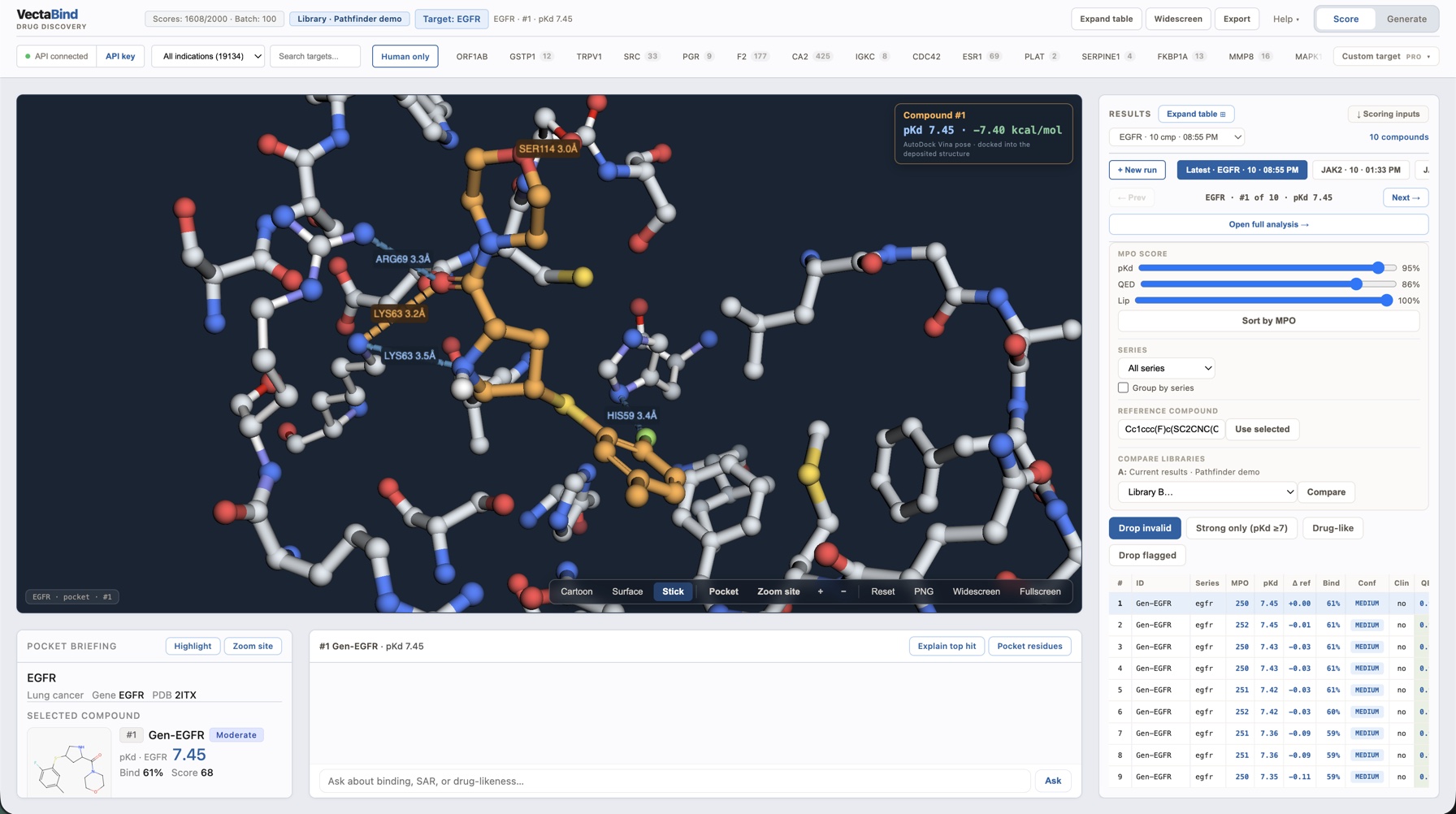
Real scored output from the workbench — not a headline MAE. GEN-12 shows predicted pKd 8.06, 80% ChEMBL similarity to a published analog, QED 0.94, and Lipinski compliance. You can verify every signal.
Drug-like · high confidence · CHEMBL551595 analog
Stage 6 EGNN affinity head outputs predicted pKd and binding probability per target pocket.
QED, Lipinski, LogP, and MPO weighting from RDKit — the same filters med chem uses daily.
ChEMBL Tanimoto similarity surfaces analogs you can look up and compare in public databases.
| Signal | Source |
|---|---|
| pKd | VectaBind model |
| QED · Lipinski · LogP | RDKit |
| Similarity | ChEMBL |
| Pocket · 3D view | PDB structure |
| CSV export | Workbench session |
Import HTS decks, generated sets, or SAR series — score the full list with progress, sortable results, MPO filters, SAR scatter, and CSV export. Compound IDs and series tags carry through from your library.
Real protocol stages, not a product tour. Each step maps to a tab in the Hit Triage Workbench.
Import CSV with SMILES, compound IDs, and series tags — up to 1,000 structures per library.
Select targets by disease area — oncology, neuro, cardio — not PDB codes alone.
Rank full libraries by pKd, MPO, and confidence. SAR scatter, selectivity heatmap, CSV export.
REINVENT4 RL with affinity as reward. Push hits back into your library and re-score.
Upload a compound set (10 or 1,000 SMILES), select a target, and get a ranked affinity table in minutes. IDs, series tags, and confidence tiers surface automatically so you know which hits to advance.
REINVENT4 integration runs goal-directed generation using the affinity model as the scoring oracle. Molecules are generated and scored in the same pipeline — no manual transfer steps.
Interactive pocket viewer with contact labels. Pocket Briefing shows target metadata and selected compound structure. Ask binding, SAR, and drug-likeness questions without writing queries.
VectaBind is optimized for relative ranking within a library on a fixed target, not for predicting experimental Kd to two decimal places. See Validation for reproducible EGFR examples and ChEMBL-grounded spot-checks.
Spearman ρ within a target — do stronger binders score higher than weaker ones in your series?
% of predictions within 1.0 pKd of experimental values — practical tolerance for triage.
Of the compounds you would synthesize first, how many assay active?
Internal PDBBind 2020 validation MAE: 0.20 pKd (model-selection split). Literature reference models and split details in Methods · Validation page.
Honest positioning — VectaBind is a fast screening layer, not a replacement for every downstream assay or simulation workflow.
Pre-computed pocket embeddings for clinically relevant kinases, GPCRs, and enzymes.
EGFR, KRAS, CDK4/6, BRAF, HER2, VEGFR2, MET, ALK + 70 more
BACE1, MAPT, SNCA, LRRK2, APP + 30 more
ACC2, PCSK9, Factor Xa, Thrombin, ACE2 + 40 more
JAK1/2, TNF-α, IL-6R, COX-2, PDE4, BTK + 45 more
SARS-CoV-2 Mpro, Influenza NA, HIV-1 PR + 35 more
Metabolic, rare disease, mental health, liver, lung, bone, skin, eye
No credit card required for the free tier.
Get free API access in minutes. Upload a library and batch-score up to 1,000 compounds on 70+ targets.