VectaBind Platform

Drug discovery,
fully interactive.

Score libraries up to 1,000 compounds, triage HTS hits by disease indication, run multi-target selectivity panels, visualize binding pockets in 3D, generate novel molecules with AI, and get instant scientific insights — all in one browser-based platform. No installation required.
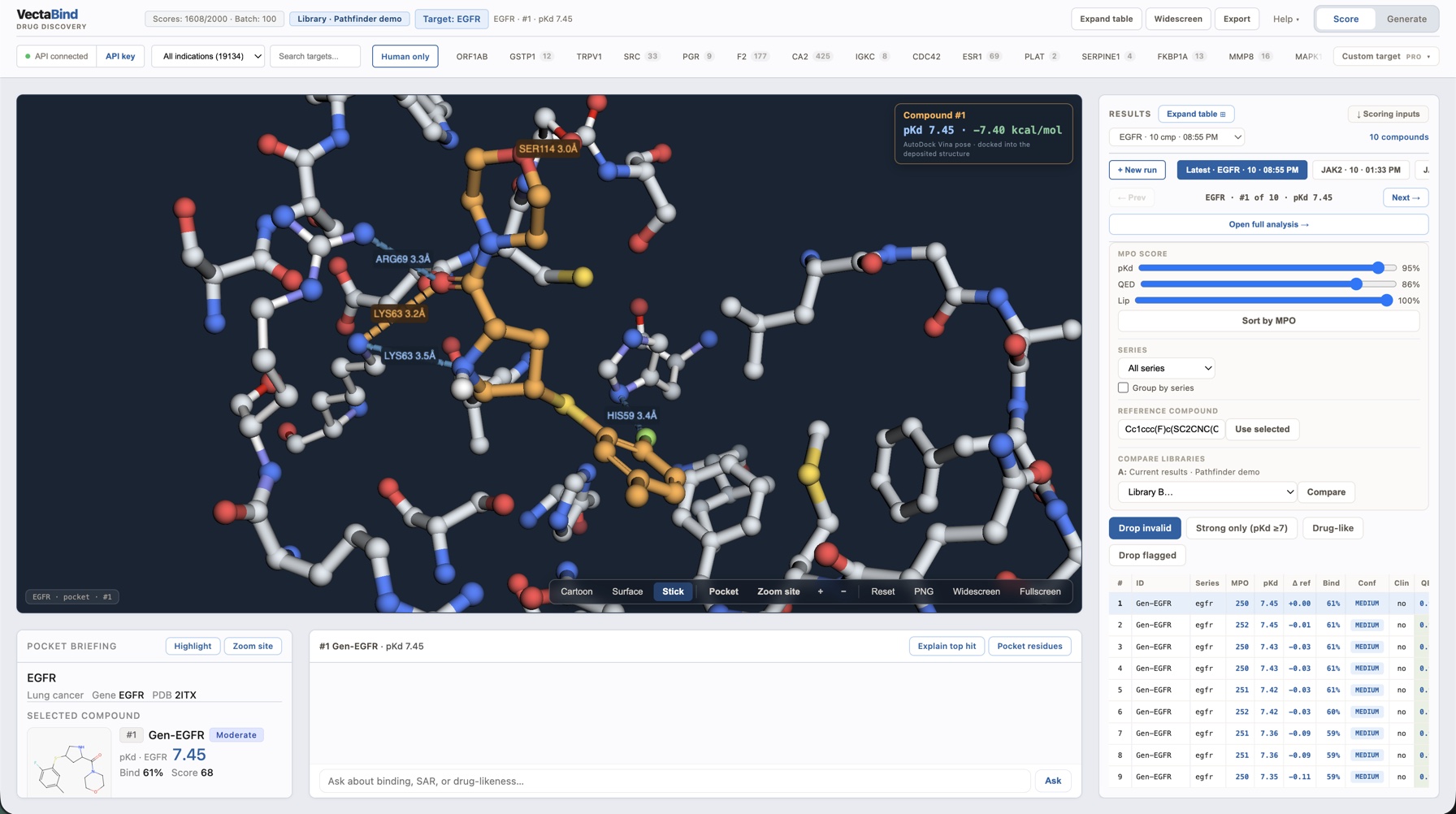
VectaBind platform: EGFR pocket with a docked pose, contact labels, and the ranked results table

Everything you need to find hits faster

Built for computational chemists, medicinal chemists, and drug discovery teams who need speed and accuracy.

Med chem

Hit Triage Workbench

Upload CSV libraries (up to 1,000 compounds) with compound IDs and series tags. Validate SMILES upfront, batch-score with progress, filter by potency and drug-likeness, export ranked results, and bridge generated hits back from the Generate tab.

Selectivity

Multi-target selectivity panel

Screen the same library against every target in an indication — e.g. FLT3, JAK2, BTK for AML. Heatmap with pKd color coding and selectivity gap (Δ) per compound. Export panel CSV for team review.

Core

Binding affinity scoring

Score any SMILES string against 4,541 proteins (19,134 pocket structures). Get predicted pKd and binding probability in under a second. Predictions currently derive from the ligand graph and the pocket sequence embedding; the geometric pathway is inactive (see Methods). On 516 structures released after the training data, MAE is 1.22 pKd after recalibration and rank correlation is ρ = 0.39 — useful for coarse triage, not for ordering close analogs. See Validation for the full external benchmark.

The scoring backend is pluggable — and one rung is deliberately switched off.

Scoring runs through a backend interface with two implementations. Stage 6 is what serves every request today: fast (~0.1 s/compound), externally benchmarked at MAE 1.22 and ρ = 0.39, suited to screening a large library down to a shortlist.

A second backend for Boltz-2 (MIT-licensed, open weights, jointly predicts structure and affinity, approaches free-energy-perturbation accuracy) is implemented but not enabled. It requires GPU hardware we do not currently run, so it reports unavailable and every request falls back to Stage 6. No prediction you have ever received came from it.

We mention it because the two are complementary rather than competing: a co-folding model is too slow to screen a million compounds, and a coarse filter is too weak to rank the survivors. Screening cheaply and then scoring the shortlist accurately is the arrangement that makes both useful. If accuracy matters more than throughput for your work, enabling it is a configuration change rather than a rewriteget in touch and we will stand it up.

Every scored compound is also matched against 765 curated structural alerts (PAINS, BRENK, NIH). Flagged compounds carry the matching alert names and can be filtered out of a library in one click. This is exact substructure matching on parsed molecules, not a prediction — you can check any individual flag against the published catalogs.

3D

Interactive 3D pocket viewer

Visualize binding pockets in cartoon, surface, or stick mode. After batch scoring, the top hit overlays in the pocket with contact annotations. Export PNG snapshots, use keyboard shortcuts, or control the view from the pocket assistant.

AI

AI molecule generation

Use REINVENT4 reinforcement learning to design novel molecules optimized for your target. The generative model learns what VectaBind predicts as high-affinity and explores that chemical space.

Claude

VectaBind AI assistant

Ask questions about the binding pocket, get insights on scored compounds, or say "zoom to active site" and "highlight pocket" to control the 3D viewer with natural language. Powered by Claude.

From compound to insight in minutes

VectaBind fits directly into your existing drug discovery workflow as a fast computational filter before expensive assays.

1

Pick indication & target

Use the Indication dropdown in the target bar to filter by disease area — oncology, hematology, CNS — then select a target. Gene symbols and PDB IDs shown for each entry.

2

Import your library

Upload CSV/TSV with SMILES and optional metadata, or paste SMILES directly. Save named libraries in your browser.

3

Score or screen panel

Single-target ranking with sortable table and SAR scatter, or multi-target heatmap for selectivity triage across an indication.

4

Export & generate

Download CSV for Excel or your ELN. Generate RL-optimized analogs and push top hits back into the library for re-scoring.

Built for real drug discovery work

Every feature is designed around how medicinal chemists actually work.

3D Visualization

Real protein structures, not cartoons

Every binding pocket is loaded from actual crystallographic data. Switch between cartoon, surface, and stick views instantly. The electrostatic surface shows you where positive and negative charges cluster — critical for understanding binding selectivity.

  • Drag to rotate, scroll to zoom
  • Click any atom to identify the residue; double-click for tighter zoom
  • Auto-overlay top scored hit with dashed H-bond / contact lines
  • Cartoon, surface, stick · PNG export · keyboard shortcuts (1/2/3, R, F)
  • Highlight binding pocket or zoom to active site via chat
  • Widescreen and fullscreen modes for presentations
EGFR · Electrostatic Surface · 1M17
Cartoon
Surface
Stick
Reset
Hit Triage

SAR within five minutes

Built for HTS triage and SAR series ranking — not generic "paste SMILES." Import compound libraries with IDs and series tags, validate structures before burning quota, and export ranked CSVs your team can paste into Slack or Excel.

  • Template CSV download with id, name, series, smiles, notes
  • Indication filter — AML, breast, lung — maps to relevant kinase panels
  • Sortable results table with pKd, bind %, MW, LogP, QED, Lipinski
  • pKd vs LogP scatter for quick med-chem triage
  • Generate → Library bridge to re-score RL hits with full model
Hit Triage · Compound library
Upload CSV Run batch score Screen panel
42 valid · 3 invalid SMILES
ID
FLT3
JAK2
Δ
CMPD-1
7.8
5.9
1.9
Compound Scoring

Screen libraries with full physicochemical context

Paste or upload a library and get ranked predictions in seconds. Each compound shows predicted pKd, binding probability, molecular weight, LogP, QED drug-likeness score, and ChEMBL similarity to known drugs.

  • Batch scoring with tier-aware chunking and progress bar
  • Filter chips: drop invalid, strong only (pKd ≥7), drug-like
  • Multi-target heatmap for selectivity across an indication panel
  • Export single-target or panel CSV for your team
#1
COc1cc2ncnc(Nc3cccc...)c2cc1
8.42
#2
CCCOc1cc(N2CCC(Oc3ccc...)...
7.91
#3
CC(C)CC1=CC=C(C=C1)C(C)...
7.34
AI Assistant

Ask anything about your target

VectaBind AI knows your current target, your scored compounds, and the 3D structure. Ask scientific questions and get expert-level answers. Control the viewer with natural language commands.

  • "What residues are in the active site?"
  • "Zoom to active site" — viewer responds instantly
  • "What makes a good binder for EGFR?"
  • "Explain the top scored compound"
VectaBind AI · Powered by Claude
VectaBind AI ready. Ask me about EGFR binding pocket or say "zoom to active site".
What makes a good EGFR binder?
For EGFR, good binders typically target the ATP-binding site (T790 gatekeeper). Key features: anilinoquinazoline or pyrimidine scaffold, H-bond to Met793 backbone, hydrophobic contact with L718/V726. Target pKd 8-10, MW under 500 Da, LogP 2-4.
Highlight binding pocket
Binding pocket residues highlighted in blue. Key catalytic residues shown in stick representation.

Start screening your compounds

Free tier includes 2,000 scores/month, 150 docking runs, and access to every scoreable target. No credit card required.

Launch app free